

Music therapy helps teens manage their emotions by using music, with a trained therapist, to notice what they’re feeling, express it, and calm their body when emotions run high. Over time, those skills can carry into everyday life, so a teen has more ways to cope when stress, sadness, or anger shows up.
Most teens already turn to music when their mood shifts. Research on how adolescents use music found that teens actively use music to regulate their moods, with girls and older teens doing so most often. Music therapy builds on that habit. It takes something teens already relate to and turns it into a structured way to understand and handle big feelings.
Key Takeaways:
- Music therapy uses music, guided by a trained therapist, to help teens notice, express, and manage their emotions.
- Music can calm the body’s stress response and activate the brain’s reward system, which helps explain its effect on mood.
- Music therapy is different from listening on your own because it’s led by a board-certified music therapist and built around specific goals.
- Teens don’t need any musical experience to benefit.
- Music doesn’t always help. Listening to sad songs for long stretches can keep some teens stuck in a low mood.
- Research suggests music therapy works best as one part of a broader mental health treatment plan.
How Music Affects Emotions
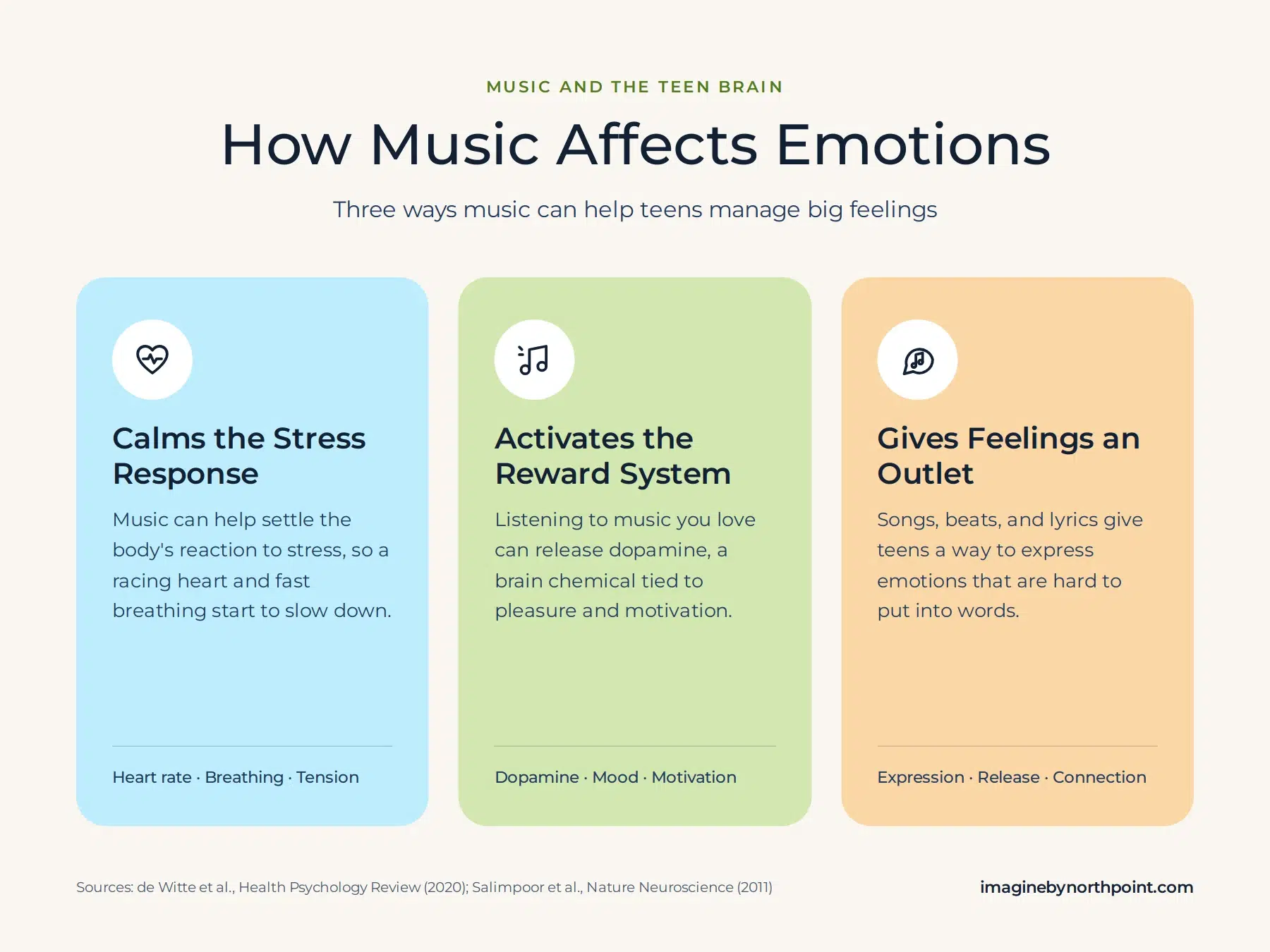
Music has a real effect on both the body and the brain. That’s part of why a single song can change a teen’s mood in a few minutes, and why therapists can use music on purpose to help with emotions.
It Can Calm the Body’s Stress Response
When a teen feels stressed or overwhelmed, their body reacts. Their heart rate climbs, their breathing speeds up, and their muscles tense. Music can help settle that response. A review of 104 studies found that music reduced stress both in how stressed people felt and in physical signs like heart rate. Some studies have also found lower levels of cortisol, the body’s main stress hormone, though results on cortisol have been mixed.
It Activates the Brain’s Reward System
Listening to a song you love does more than feel good in the moment. In one brain imaging study, people who listened to music they found deeply moving released dopamine, a brain chemical tied to pleasure and motivation. The release even happened in the moments leading up to a favorite part of a song. That helps explain why music can lift a teen’s mood, and why it can feel motivating when other things don’t.
It Gives Feelings an Outlet
Many teens have a hard time putting emotions into words, especially when those emotions feel confusing or embarrassing. Music offers another way in. A teen might not be able to explain why they feel angry, but they can pick a song that matches the feeling, play a beat that releases it, or write a line about it. This is one reason music-based approaches can work well for teens who don’t open up easily in therapy.
Music Therapy vs. Listening to Music on Your Own
Listening to music on your own can help with stress and mood. Music therapy is different because it’s guided by a trained professional and built around specific goals. Here’s how the two compare.
| Listening on Your Own | Music Therapy | |
|---|---|---|
| Who guides it | The teen | A board-certified music therapist |
| Goal | Relaxing, enjoying music, or shifting a mood | Building specific emotional and coping skills |
| How music is used | Mostly listening | Listening, songwriting, playing, singing, and talking about the music |
| Hard feelings that come up | May pass, linger, or grow | A therapist helps the teen notice, name, and work through them |
| Where it fits | Everyday self-care | Part of a broader mental health treatment plan |
Both have a place. Everyday habits like building a mood playlist or writing lyrics in a notebook can still make a difference, and there are plenty of music therapy activities teens can try at home between sessions or on their own.
What Happens in a Session
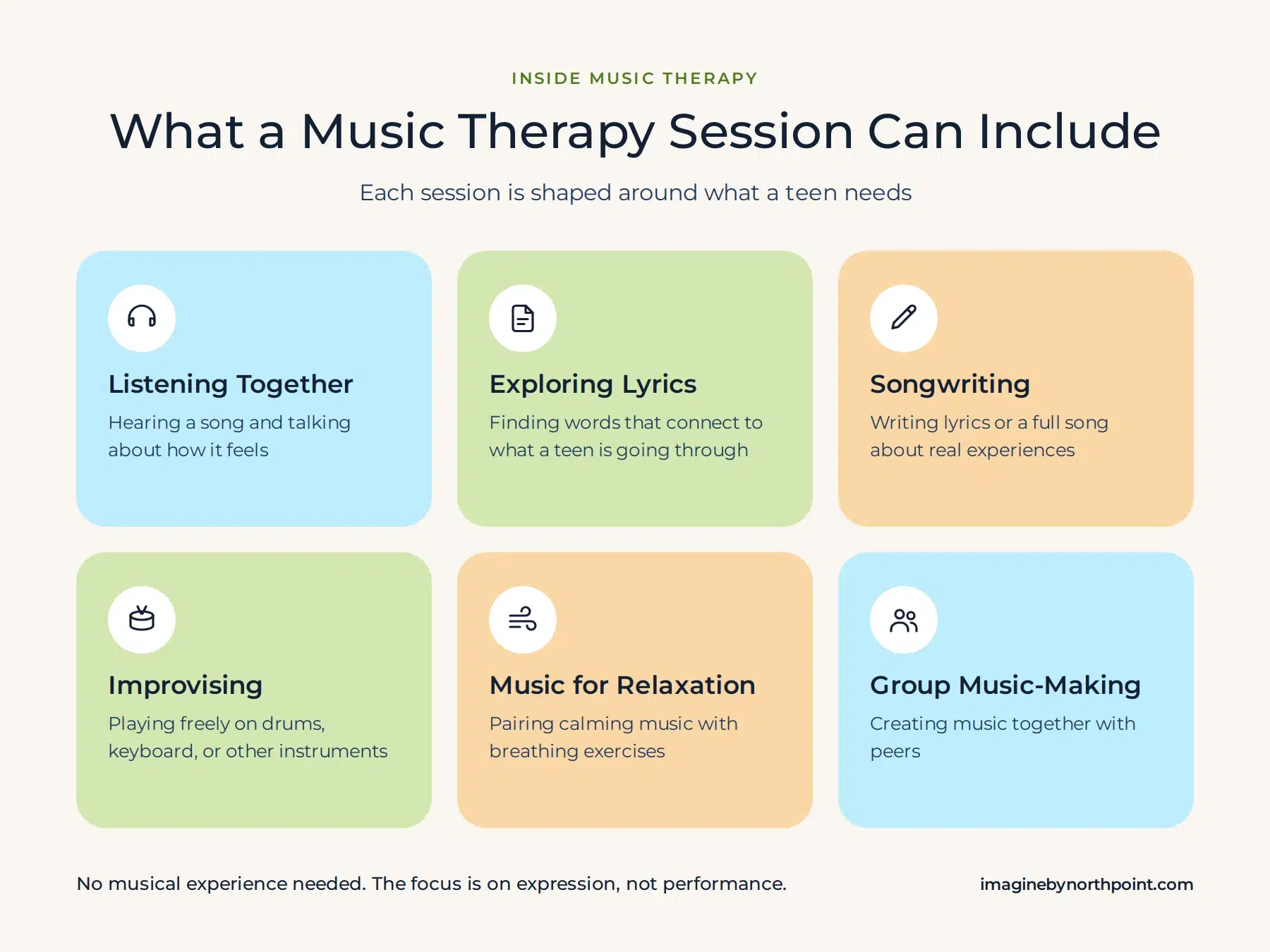
No two sessions look exactly the same, because each one is shaped around what a teen needs. A session may include:
- Listening to a song together and talking about how it feels
- Exploring lyrics that connect to something the teen is going through
- Writing lyrics or a full song
- Improvising on drums, keyboard, or other instruments
- Pairing calming music with breathing or relaxation
- Making music with peers in a group setting
Teens don’t need any musical training to take part. The focus is on expression and building skills, not performance. A teen who has never touched an instrument can get just as much out of a session as one who plays in a band.
Who Leads Music Therapy
Music therapy is led by a board-certified music therapist, a clinician trained in both music and mental health. In the U.S., the Certification Board for Music Therapists is the only organization that certifies music therapists. Therapists who earn its credential use the title MT-BC (Music Therapist-Board Certified). To get there, they complete a degree in music therapy, supervised clinical training, and a national board exam.
That training matters. A music therapist knows how to use music to reach specific treatment goals, how to respond when a song brings up something painful, and how music therapy fits alongside the other care a teen may be receiving.
How Music Therapy Builds Emotional Regulation Skills
Emotional regulation is the ability to notice a feeling, understand it, and respond in a way that doesn’t make things worse. Teens are still developing this ability, and like other emotional regulation skills for teens, it gets stronger with practice. Music therapy gives teens a low-pressure way to practice in a few key areas.
Naming Feelings
A therapist might ask a teen to choose a song that matches how they feel today, then talk about what in the song fits. Over time, this helps teens build a bigger vocabulary for their emotions. Being able to say “I feel left out” instead of just “I feel bad” makes a feeling easier to manage.
Staying in the Present Moment
Focusing on a rhythm, a melody, or the words of a song pulls attention into the present. This works a lot like mindfulness, which helps teens notice feelings without getting swept away by them. When a teen’s thoughts are racing, having something steady to focus on can bring the intensity down.
Finding Steadiness in Rhythm
Music has structure: a steady beat, repeating patterns, and a predictable shape. For a teen whose emotions feel chaotic, playing or following a rhythm can bring a sense of order and control. Drumming, for example, gives restless energy somewhere to go while keeping it contained.
Expressing Emotions Safely
Anger, grief, and frustration don’t go away when they’re bottled up. Writing a song, playing loudly, or improvising lets teens release strong feelings in a way that doesn’t hurt themselves or anyone else. Afterward, there’s often space to talk about what came out.
Connecting With Others
In group therapy settings, making music together can help teens feel less alone. Playing in sync with others takes listening and cooperation, and sharing songs can open conversations that might feel too hard to start otherwise.
When Music Helps and When It Can Make Things Worse
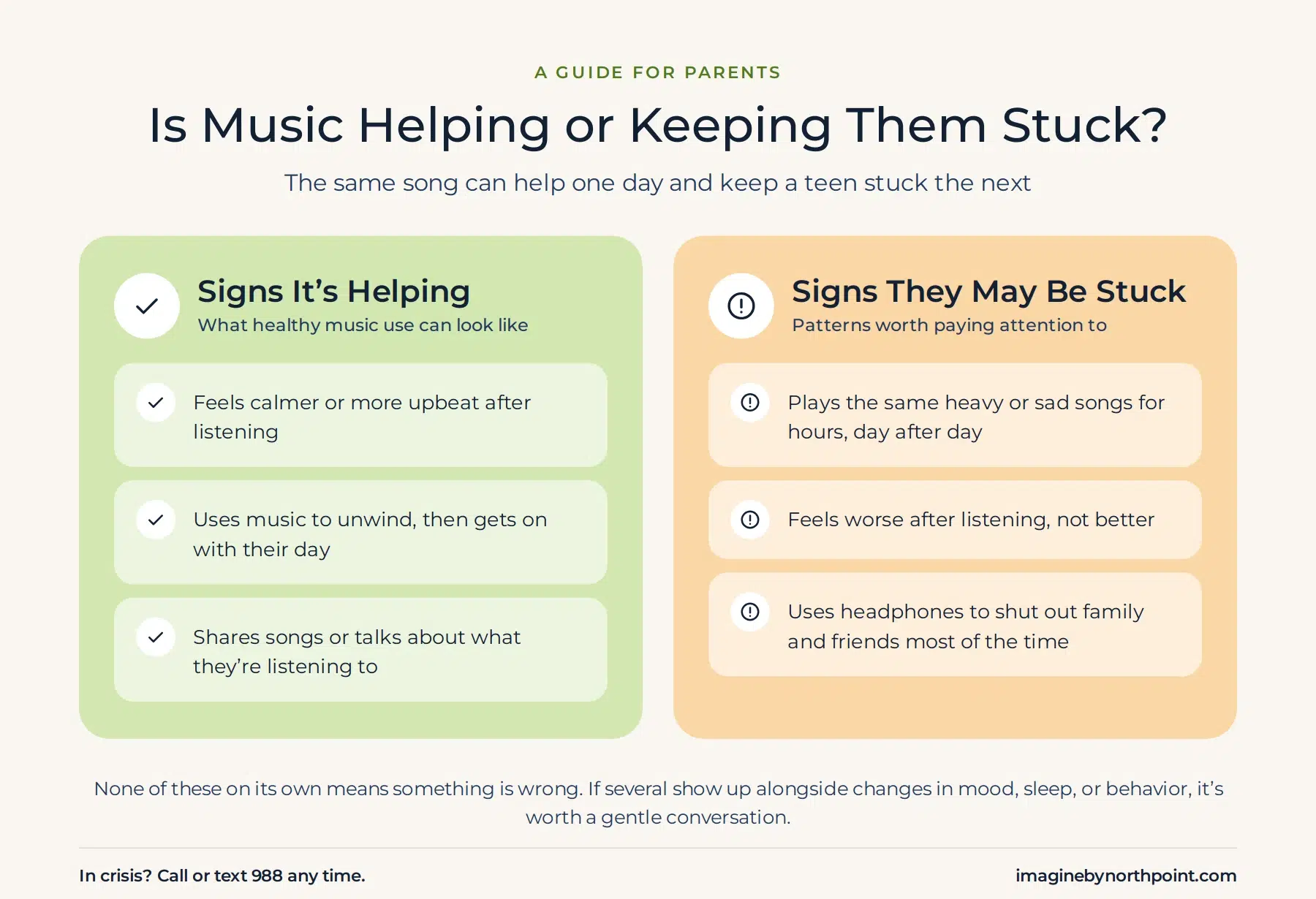
Music doesn’t always lift a teen’s mood. The same song can help one day and keep a teen stuck the next. Researchers who study how young people use music have found that listening to sad music during a sad time can be healthy in the short term, like when someone is grieving. But if that pattern goes on for a long time, it can turn into a cycle of dwelling on painful feelings, especially for teens who are already prone to depression.
Some signs that a teen’s music habits may be feeding a low mood instead of helping:
- Listening to the same heavy or sad songs for hours, day after day
- Feeling worse after listening, not better
- Using headphones to shut out family and friends most of the time
- Being drawn to lyrics that focus on hopelessness or self-harm
None of these on its own means something is wrong. But together, or alongside other changes in mood, sleep, or behavior, they’re worth a gentle conversation. This is also where music therapy can help. A therapist can work with a teen to notice how different music affects them and shift toward choices that actually help.
If Your Teen Is in Crisis
If your teen talks about wanting to die, hurting themselves, or feeling hopeless, take it seriously. You can call or text 988 to reach the 988 Suicide & Crisis Lifeline any time, day or night.
If your teen is in immediate danger, call 911.
What the Research Says About Music Therapy for Teens
Research on music therapy for teens is promising, though still growing.
In one of the largest studies so far, 251 children and teens ages 8 to 16 with emotional and behavioral challenges were split into two groups. Those who received music therapy alongside their usual care had better self-esteem and lower depression scores after 13 weeks than those who received usual care alone. The researchers noted that more study is needed.
A Cochrane review on music therapy for depression found that adding music therapy to standard treatment led to short-term improvements in depression, and likely in anxiety as well. The same review called for more studies focused on children and teens.
Overall, the research suggests music therapy works best as one part of treatment, not as a replacement for it. It can reach teens in ways talk-based approaches sometimes don’t, especially teens who already have a strong connection to music.
Frequently Asked Questions About Music Therapy
1. Does a teen need musical experience to do music therapy?
No. Music therapy doesn’t require any musical training or talent. The focus is on expressing feelings and building coping skills, not on performing, so teens of any experience level can take part.
2. How is music therapy different from listening to music?
Listening to music on your own can help with mood and stress, but music therapy is guided by a board-certified music therapist and built around specific goals. Sessions may include songwriting, playing instruments, and talking about how music connects to what a teen is feeling.
3. Can music therapy help teens with anxiety and depression?
It may. Research suggests that music therapy added to standard treatment can reduce symptoms of depression and anxiety in the short term. It works best as part of a broader treatment plan rather than on its own.
4. What does a music therapist do?
A music therapist is a trained clinician who uses music to help people reach mental health goals. With teens, that can mean helping them name emotions, release stress, and practice coping skills through listening, writing, and making music.
5. Can music make a teen’s mood worse?
Sometimes. Listening to sad music during a hard time can be healthy for a while, but if a teen keeps returning to the same heavy songs and feels worse afterward, it may be keeping them stuck in a low mood.
Finding the Right Support for Your Teen
If your teen is struggling to manage their emotions, the right support can make a real difference. At Imagine by Northpoint, teens work with a care team to build coping skills through a range of therapies for teens, including creative and expressive approaches. Depending on what your teen needs, care may take place in an intensive outpatient program or a partial hospitalization program. Reach out to our team to talk through options and find the right fit for your family.